Data, Insights and Blog Posts
Using Local Regression to Infer Cutoffs in Administrative DataEconomists increasingly rely on administrative data for research. However, because such data are typically collected for non-research purposes—or at least not with specific economics research in mind—they often lack crucial information, such as the cutoff scores used to determine eligibility for programs (e.g., benefit eligibility). Academic records, for example, frequently omit admission cutoff scores for academic programs. In these cases, researchers may infer the missing cutoff values from the data itself, particularly when detailed information is available on the outcomes of individuals whose participation depended on those cutoffs. When datasets are sufficiently rich and well structured, such methods can accurately recover the original cutoff criteria.
This short post describes a method I implemented in my own research using students' academic records. The starting point is a dataset of pre-college admission-exam records in which admission cutoff scores are missing for certain cohorts. The goal is to infer these missing cutoffs using the exam data alongside information on the universe of students enrolled in the pre-college program. Because admission cutoffs can vary across demographic groups, the first step is to define a relevant subgroup or “cell” (e.g., female students in the 2012 cohort from a specific administrative region). Once a cell is defined, the researcher can estimate a series of local linear regression discontinuities (RD) centered at each distinct test score, using program participation (i.e., enrollment in the pre-college program) as the outcome variable. The cutoff for each cell can then be identified as the score corresponding to the largest discontinuity in enrollment rates among general high school graduates. Finally, the researcher should test whether the estimated cutoff exhibits a statistically significant discontinuity, confirming that the inferred score reflects a genuine threshold in the selection process.
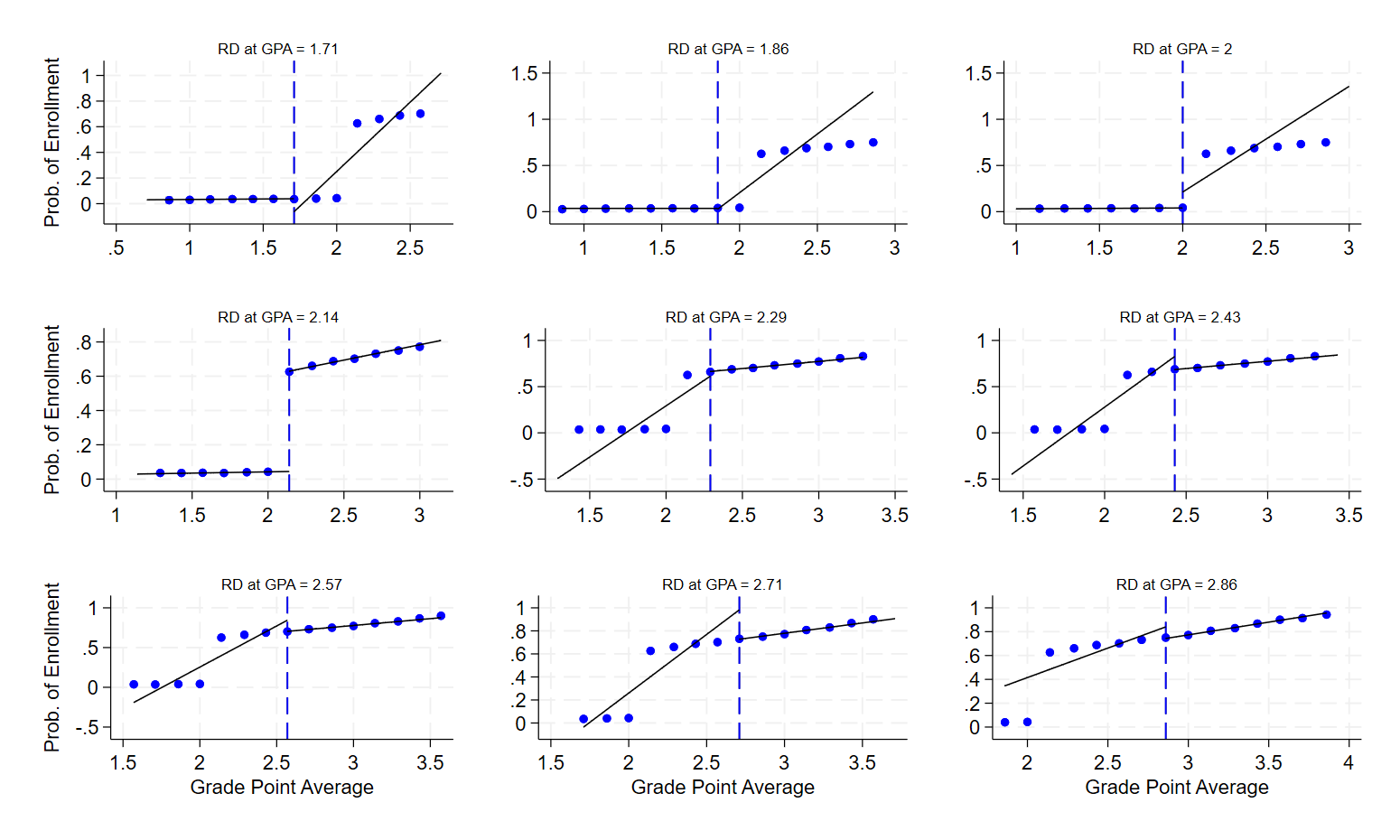
The figure above illustrates the estimated discontinuities at several Grade Point Average (GPA) values for cohorts of students in Ethiopian general high schools who took the pre-college admission exams in the summer of 2012. The example focuses on female students in five major administrative regions, including the capital, Addis Ababa. The method identifies GPA 2.14 as the pre-college admission cutoff for female students in this cohort. Interestingly, official records from the National Educational Assessment and Examinations Agency (NEAEA) show that the cutoff is GPA 2.29. Given the sharp discontinuity at GPA 2.14 and the absence of any meaningful discontinuity at GPA 2.29, the official record appears erroneous. This discrepancy suggests that researchers should not always take official records at face value and should verify their validity whenever possible.
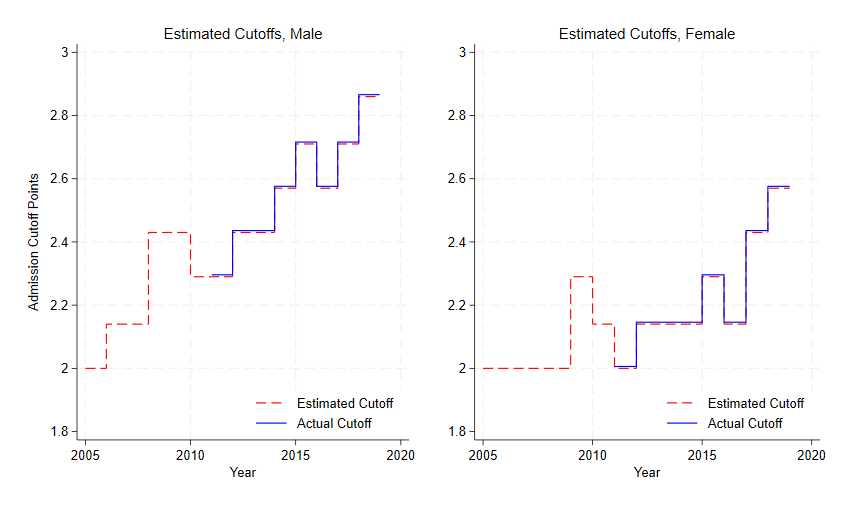
The figure below presents the estimated cutoffs for male students in periods in which cutoff data are missing, as well as robustness checks for periods in which official cutoff records exist. Comparable estimates for female students are available upon request. Sample code is available here.
Researchers interested in implementing this approach with more complicated data and settings can consult the related paper (2025).
Back to Data & Insights